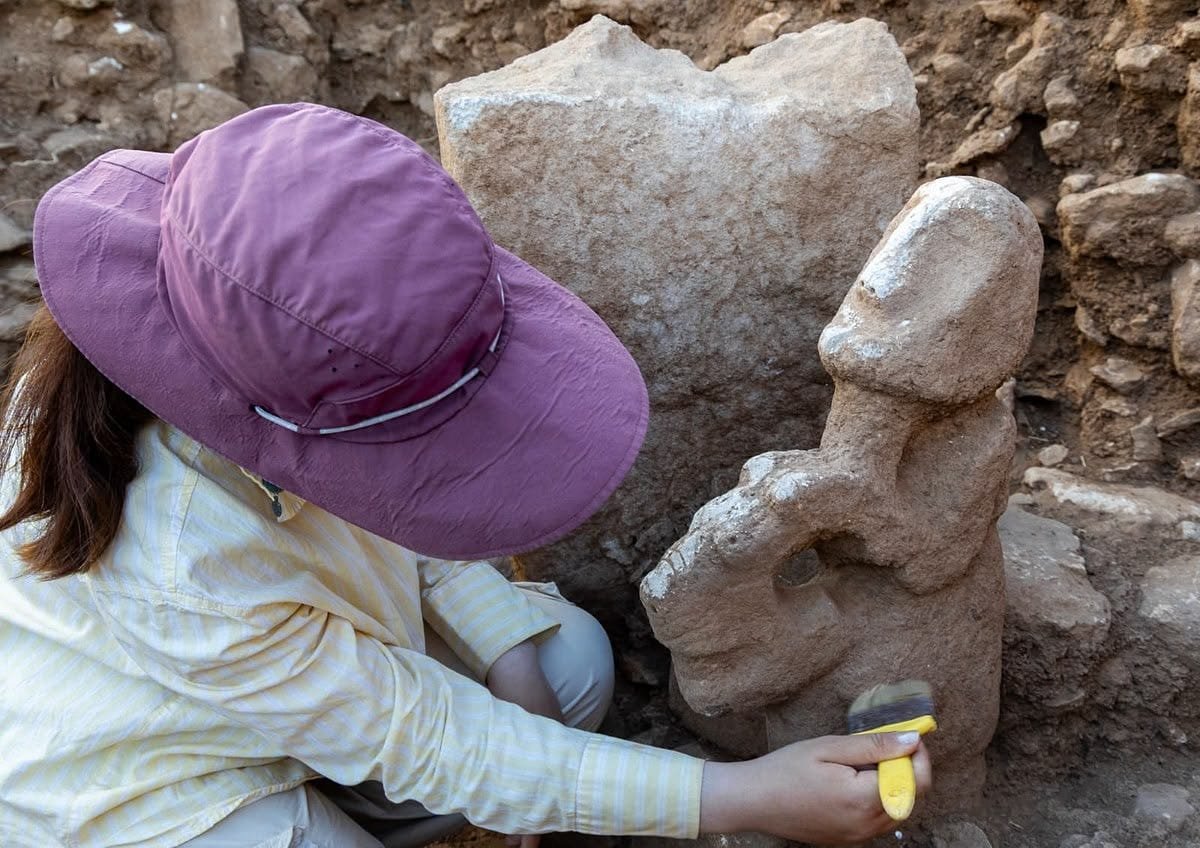

Seventy centimetres. That is the height of the sculpture just brought to light at Karahantepe, in Şanlıurfa. Not a monumental pillar, not one of the towering figures that have made headlines in recent seasons. A small thing, by the standards of that landscape — and possibly the most interesting object to come out of the Taş Tepeler region in some time.
It shows a human figure seated on the back of a leopard. It was found on a bench running along the wall of a round structure roughly three metres across, its floor paved with flat stones. It is composite: two beings carved as one. And, according to the archaeologists working the site, its style does not match anything previously known from Karahantepe.
That last detail is the one I keep returning to.
We have grown used to a certain rhythm in the reporting from this region. Each season brings something older, larger, more elaborate, and each announcement is folded into a familiar sentence about the dawn of civilisation. The sentence is not wrong. But it flattens something. Taş Tepeler is extraordinary not because it settles the question of our beginnings. It keeps unsettling it.
Consider what this object implies. Eleven thousand years ago, before pottery, before writing, before anything we would recognise as a city, someone in this landscape thought it worth carving a person and a predator into a single form and placing it where people gathered. Not a hunting scene. Not a trophy. A relationship — one whose terms we cannot read. Was the leopard a mount, a companion, an ancestor, a threat held in check? We do not know. We may never know.

I have spent a long time in the business of taking people to places and explaining them. The temptation of the profession is to arrive with the answer already packed. Here is the site, here is what it means, here is why it is the oldest of its kind. It makes for a tidy day. It also quietly misrepresents what archaeology actually is, and that argument is still in progress.
The honest offer is different, and I think better: come and stand in front of something that no one can yet explain. Not the oldest, not the first — those are marketing words, and they age badly. Rather, the newest edge of what we know, which is a genuinely rare thing to be able to visit.
A line has stayed with me since I first read it, and this find brought it back: some of the most important stories in human history were told not in writing, but in stone. We are still learning to read them. Sometimes a discovery answers a question. More often — and more valuably — it leaves us with a better question than the one we came with.
Eleven thousand years on, this figure and its leopard are still capable of stopping a person in their tracks and making them ask what on earth they are looking at.
That, by itself, is reason enough to go.
Karahantepe lies roughly thirty kilometres from Göbeklitepe and is one of more than a dozen Neolithic sites in the Şanlıurfa plateau known collectively as Taş Tepeler. The region rewards being travelled as a whole rather than visited as a single monument.
Pictures are from the Minister of Culture’s social media.