Eğer Alice Harikalar Diyarın ’da uyarlaması bir film çekmem istenseydi her halde güzergâh olarak Alsace bölgesini tercih ederdim. Her iklime adapte olabilen bu coğrafya Fransa’nın kuzeydoğusundaki Haut-Rhin ve Bas-Rhin illerini kapsayan ve tarihi Alsace bölgesiyle kabaca çakışan önemli bir bölge. Başkenti ise Strasbourg’dur.
Julius Caesar’da birinci yüzyılda himayesi altına alınan bu coğrafya zamanla Fransa’nın en renkli kültürel, tarihsel ve lezzetli rotasına dönüştü. Alsace ve onu dolduran nufüsü genellikle her zaman bir karmaşa içerisinde olmuş. Kutsal Roma İmparatorluğun’dan sonra 17. yüzyılda Fransa’nın bir parçası olan Alsace maalesef huzura ermeden bu defa da Almanya ile birlikte sınır sorunları yaşadı. Almanlara göre Alsace’ın sınırı Vosges dağı ile birlikte sınırlanması gerekirken Fransız’Larda tes bir tez ile gelerek bu sınırın Almanlar için Ren nehrin’de bitmesi gerektiğini iddia etti. Ufak olmasına rağmen Alsace 75 yıl boyunca dört defa el değiştirdi. Bir zamanlar Alman iken daha sonra Fransız oldu. 1871 yılındaki Franko-Prussian savaşının kaybedilmesiyle yine Alman oldu. Birinci Dünya Savaşı sonrası tekar Fransız oldu.
Bu karma kültürün bir bölümü bölgesel diyalekte dayanıyor. Bir kafe de konuşulan dile kulak kabartınca sanki Almanca’ya da kendinizi hissediyorsunuz oysa çok kaba bir Fransız diyalekti konuşuluyor. aslına bakarsanız Alsace, Almanca lehçesine sahip ufacık bir Fransa.
Ren Nehri ile Vosges dağı arasında sıkışan 190 km uzunluğunda, 90 km genişliğinde olan Alsace, özellikle Fransanın kültürel harmanlamasını fazlasıyla yaşatan bir bölge. Alman, İsviçre ve Flaman köklerine dayanan Alsace ufacık köyleri, dar sokakları, renkli ve sıcak yerel pazarları ile özellikle son dönemlerin h-gezginler tarafından parmakla gösterine güzergahı.
To the north and east it shares a border with Germany; to the south with German-speaking Switzerland, and to the west with Lorraine and Franche Comté.
Kuzey ve doğu da Almanya ile sınır paylaşan Günümüzde Alsace Fransa’nın bir parçası ve akın akın turistleri kendisine çekiyor. En önemli cazibesi ürettiği eşsiz şaraplar, peynirler ve tablo değerinde olan gerçek zamanlı köyleri. Öte yandan bu bölgede yaşayanların isimlerindeki harmanlama da oldukça dikkat çekici. İsimleri fransız olup soy adları Alman olan büyük bir nufus var bu da Alsace’nın tek başına farklı bir kültüre sahip olduğunun en güzel örneklerinden biri.
Elbette bahar ve sonbahar ayları gezginler için daha bir tercih dönemi ama bence Alsace her mevsim güzel. İster yürüyüş, ister bisiklet, ister kültür ve elbette yemek. Keşfedilmeyi bekleyen bir şarap bölgesi ve olağan dışı yemek yelpazesi.
Colmar şehri bir deneyim, algılarınızı açabileceğiniz bir oluşum. 70bin nüfusu ile çok uzun zamandan beri Alan ve Fransız gezginlerin uğrak noktası. Fransa’nın diğer turistik bölgelerine kıyasla daha yeni yeni dışarıdan gelen gezginleri ağırlamaya başladı. İkinci dünya savaşında çok az darbe alan şehir 15. ve 16. yüzyılından kalma yapılarıyla, ayrıcalıklı gurme özellikleriyle hem kültürel zenginlini hem de derin tarihini gezginler ile paylaşıyor.
Colmar’daki Unterlinden Müzesi belki de Avrupa’da gezebileceğiniz en keyifli ufak müzelerden biri. Roma İmparatorluğundan kalan eserlerden orta çağ şarapçılığına, nefes kesen tablolardan entnografik değer taşıyan düğün kıyafetlerine kadar uzanan geniş bir sergisi var. Özellikle 10 tablo ve sadece 35 çizimi hayatta kalmış olan Matthias Grünewald’ın Isenheim Altarpiece adlı 500 yaşında olan 4 parçalık eseri müzenin en önemli varlıklarından biri.
Colmar’ın bir diğer özellği ise Özgürlük Abidesinin tasarımını yapan heykeltıraş Frédéric-Auguste Bartholdi’nin kasabası olması. Bizler için çok önemli olmasa bile bu heykeltıraşın Amerika’ya 100. yaşına bastığı için hediye edilen eseri dünyanın en tanınır sanatsal üretimlerinden biri. İlgili olanlar için Bartholdi müzeside ilginç olabilir.
Eğer müzeleride canınız sıkılırsa o zaman dert etmeyin. Atlayın aramanıza ve verin kendinizi Şarap Rotasına (Route du Vin). Burası 80 mil boyunca adım başı bağdan, köylerden ve feodal şatolardan oluşan bir rüyalar alemi. Seyahat edebileceğiniz en keyifli ve bol görsel niteliklee sahip bir rota. Özellikle öğleden sonra güneşin ensenize bildiği zamanlarda zicirleme bağ gezileri çok keyifli olabilir. Yol üzerinde gerçekleşsen şarap tadımları, peynir atıştırmaları mevcut olan kültüre ayrı bir lezzet katıyor.
Lezzet demişken elbette birazda yenilebilecek yemeklere değinmek gerekir. Bu menü aslında oldukça uzun. Her gezginin damak zevkine uygun leziz yemekler tatma imkanımız var. Elbette dönem dönem bölgedeki Alman etkisini sık sık sosis, patates ve soğan kızartmaları ile gönderme yapabiliyorsunuz. Fransız dokunuşuyla klasikleşen Alman sosk lezzetleri. Dikkat etmeniz gereken lezzetler arasında forchoucroute garnie (tuzlama lahana ve sosis) başı çekiyor. Bunun yanısıra Baeckeoffe (bol etli soğanlı ve patatesli güveç) her gezginin ilk on yerel lezzetinde yer alabilecek klştede. Rösti, poulet au Riesling (Riesling şarabı ile aheste aheste pişirilen tavuk)ve Spätzle Alman isimlerine kıyasla oldukça Fransız olup damağınızı zenginleştirecek tatları sunuyor. Alsace’ hiç şüphesiz derinlemesine gurme gezi işleri yapılabilir.
Eğer fazla seyahat süreniz yoksa, eğer farklı bir Avrupa’ya şahit olmak isterseniz ve klasik Avrupa görüntülerinden sıkılıp yenilik arıyorsanız Alsace sizin adresiniz olabilir. Alman katılığı içerisinde Fransız yaşam keyfi…
|
Alsace is the Germanic region of France. It is a region lying on the west bank of the river Rhine, between the Rhine and the Vosges mountains. To the north and east it shares a border with Germany; to the south with German-speaking Switzerland, and to the west with Lorraine and Franche Comté.
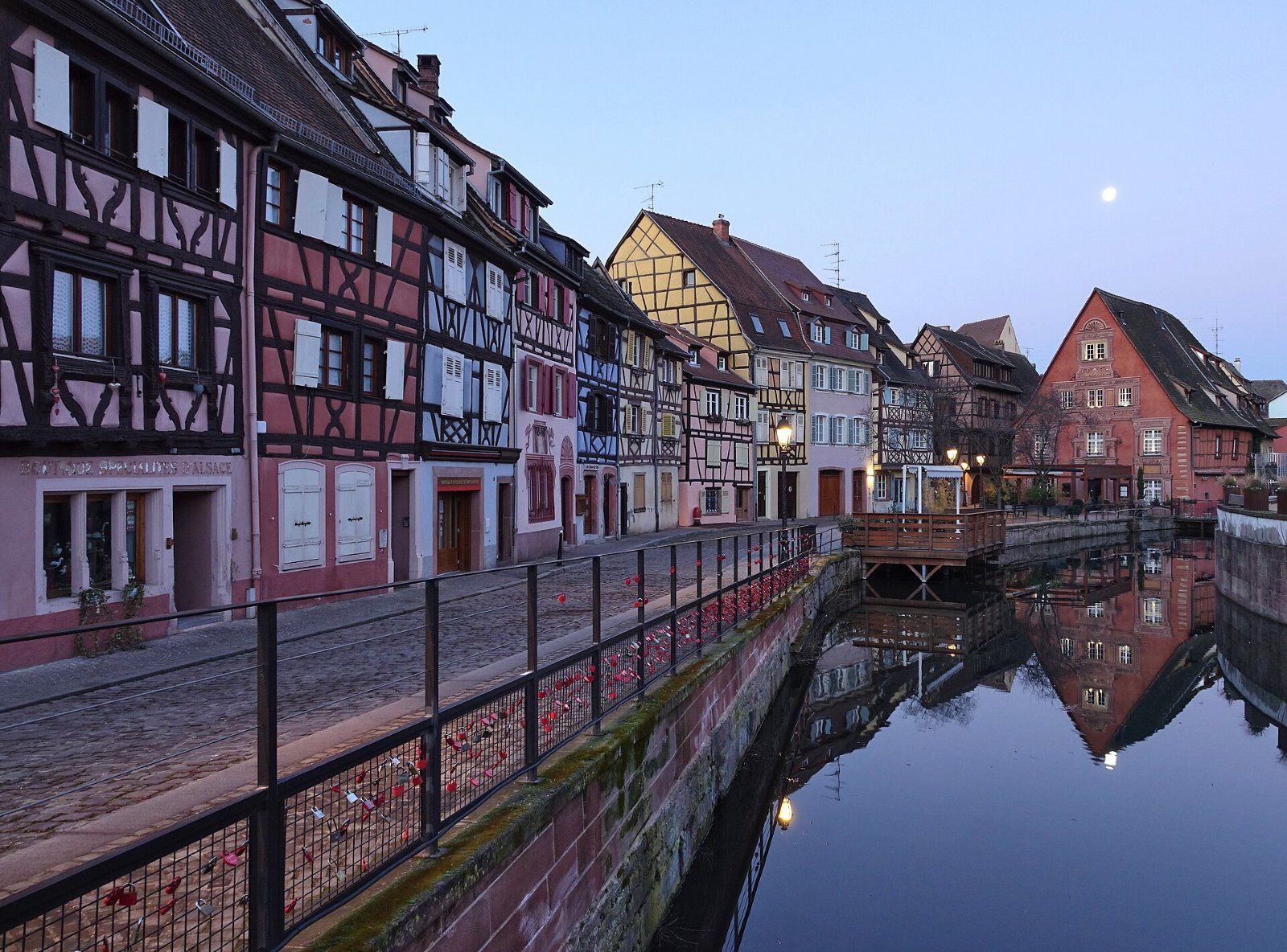
Historically speaking, Alsace was part of the German-speaking area of central Europe, and to this day a large proportion of the population, of all generations, speak or understand Alsacian, a dialectal form of German closely resembling the German spoken in Switzerland. In the last two centuries, Alsace has passed from Germany to France and back , and back again; consequently, it is a region that was not part of France at the time of the makings of the modern-day nation, and has held on to a number of institutional differences, particularly concerning religious affairs. For example, Good Friday is a public holiday in Alsace, but not in the rest of France; and in Alsace, priests are paid by the state. Heritage and cultureIn terms of heritage and culture, with its villages of brightly-painted steep-roofed half-timbered houses, Alsace is definitely germanic. While today people are free – within limits – to choose what colour to paint a building, in the past the colours had a significance, and town houses, which often had shops or boutiques on the ground floor, were painted according to the type of shop – bakeries in one colour, butchers in another, shoemakers in a third colour, and so on. Today that is no longer the case, but the tradition of brightly coloured half-timbered houses has become firmly established as the local Alsatian style. Alsace stands apart from any other region of France. The region’s capital, Strasbourg, has all the feel of a central European city. In economic terms, Alsace is part of the Rhine valley corridor, one of the most important trading routes in Europe since the Middle Ages. Consequently its economic activity has always depended as much on its Germanic neighbours as on links with other parts of France, and as a result the region has long been one of the most propserous in France.
Alsace is made up of just two departments, the Lower Rhine, orBas Rhin (67), capitalStrasbourg, and the Upper Rhine, or Haut Rhin (68), capitalColmar. The biggest city in the Haut Rhin department is howeverMulhouse,. Both of these departments are comprised of a rich fertile plain in the east – the flat lands of the Rhine valley – and the Vosges mountains in the west. Strasbourg itself is one of the many fine cities of France; its historic centre, with its magnificent gothic cathedral, is among the most visited in France, and the Petit France quarter, on the banks of the river Ill, is particularly worth a visit. Among the highlights of the city’s year is the annual Christmas Market, held around the cathedral, an event that attracts visitors from all over France and neighbouring countries. Generally speaking, Strasbourg attracts a large number of international visitors, being the one of the two seats of the European parliament. ► More on Strasbourg. Mulhouse is a major manufacturing centre; but with the French national railway museum and the Cité de l’Automobile, an impressive car museum with the world’s largest collection of Bugattis, and also the large Ecomusée d’Alsace open-air museum, this part of southern Alsace has plenty to offer the tourist. Lying at the point on the river Rhine where France, Germany and Switzerland meet, the town of Saint Louis is actually a suburb of Basel, or Bâle in French; as such it is very close to this historic Swiss city, with its prestigious art galleries. The cities of Alsace all lie in the Rhine valley; to the west of the Rhine valley, Alsace includes the eastern side of the Vosges, a range of steep and thickly wooded mountains which offer plenty of opportunities for hiking, rambling and other outdoor activities. Alsace wineAlsace wine is famous worldwide, and wine production is one of the region’s main activities. The Alsace vineyards are located along the eastern slopes at the foot of the A typical traditional Alsace village. Vosges; the area is famed for its very pretty villages, with their brightly painted half-timbered houses. Some of these villages such as Eguisheim and Riquewihr are classed as “most beautiful villages in France”, and as such tend to draw vast crowds of tourists at weekends and in the tourist season. They are very pretty; but these are just two among a large number of other very attractive villages and small towns set among the vineyards. For a more authentic view, visitors should follow the Alsace Wine Route, and stop off at some of the less visited small towns and villages, such as Niedermorschwihr or Turckheim. Turckheim and Kaysersberg are particularly worth the visit, and though they both attract lots of tourists in the high season and at holiday weekends, they are a little bit less crowded than the “most beautiful villages in France” of Riquewihr and Eguisheim Most Alsace wines are white wines, in the German tradition; Alsace vineyards are famous for their Sylvaners, Rieslings and Gewurtzraminers, wines that are not produced anywhere else in France, but are produced in German vineyard areas. The cheaper Alsace wines are Edelzwicker and Sylvaner, the most expensive ones are the Gewurtzraminer, specially those known as “vendanges tardives”, meaning late harvested grapes, which produce strongly savoured wines that are excellent as an aperitif. Other regional specialities:Alsace is famous for its beer (for example, Kronenbourg or Meteor), its sauerkraut (choucroute in French), and several other local specialities such as Alsace Flammekueche, a traditional dish that is not unlike a pizza without tomatoes, but covered with cheese, cream, mushrooms and local ham. Another local speciality is Alsatian gingerbread, known as Pain d’Epices. Alsace in winterStrasbourg’s Christmas market, theChristkindlmarik is reputedly the oldest and biggest traditional Christmas market in Europe. It has been going since 1570, and runs throughout the month of December. With the growing international success of the Christmas Market, other Christmas markets have developed in the other towns across the regions, notably Colmar, and in many of the traditional villages in Alsace such as Riquewihr. These attract visitors from all over Europe, and have helped boost the Alsace tourist industry in a month when tourism in other regiions is largely dormant. How to reach Alsace :By TGV train from Paris gare de l’Est or from Lyon. By motorway from UK / Holland via Nancy and/or Luxembourg, from Germany via Kehl. The region’s main international airport is Basel-Mulhouse Euroairport served by several airlines including BA, Swiss, Lufthansa and Easyjet. Strasbourg airport is smaller. Main tourist attractions in Alsace
|
AlsaceaccommodationHotels in Strasbourg: Click forselected hotels in central Strasbourg Alsace self catering: click for Gites in Alsace B&B in Alsace Traditional Alsace hotels A choice of selected Small hotels in Alsace |
|---|
Alsace is famous for the storks that nest on church towers and other high places.
| ►► Discover France……. |
|---|
| About-France.com home |
| Full site index |
| About-France.com site search |
| ►► Principal chapters on About-France.com : |
|
Guide to the regions of France Beyond Paris, a guide to the French regions and their tourist attractions. |
|
Guide to Paris Make the most of your trip to Paris; Information on attractions, Paris hotels, transport, and lots more. |
|
Tourism in France The main tourist attractions and places to visit in France – historic monuments, art galleries, seasides, and more |
|
Planning a trip to France Information on things to do before starting your trip to France. |
|
Driving in France Tips and useful information on driving in and through France – motorways, tolls, where to stay…. |
|
Maps of France Cities, towns, departments, regions, climate, wine areas and other themes. |
|
The French way of life A mine of information about life and living in France, including working in France, living in France, food and eating, education, shopping. |
Image: Petite Venise depuis le pont de la rue des Écoles (Colmar) (8) — Gzen92, CC BY-SA 4.0, Wikimedia Commons