Nine tunnels, six chambers and the quiet engineering of Constantinople
Many of us who organize tours of the Old City have been asked about the tunnel(s) under Hagia Sophia. The stories of these have been many and exciting: in places flooded with water, sometimes with boats floating about; with a secret passageway down to the Topkapi Palace; with a single door which swallowed up a priest on the day the city fell to the Crusaders. But when the Sultanahmet tunnels were finally uncovered this November, what was found was far less amazing but far more interesting.
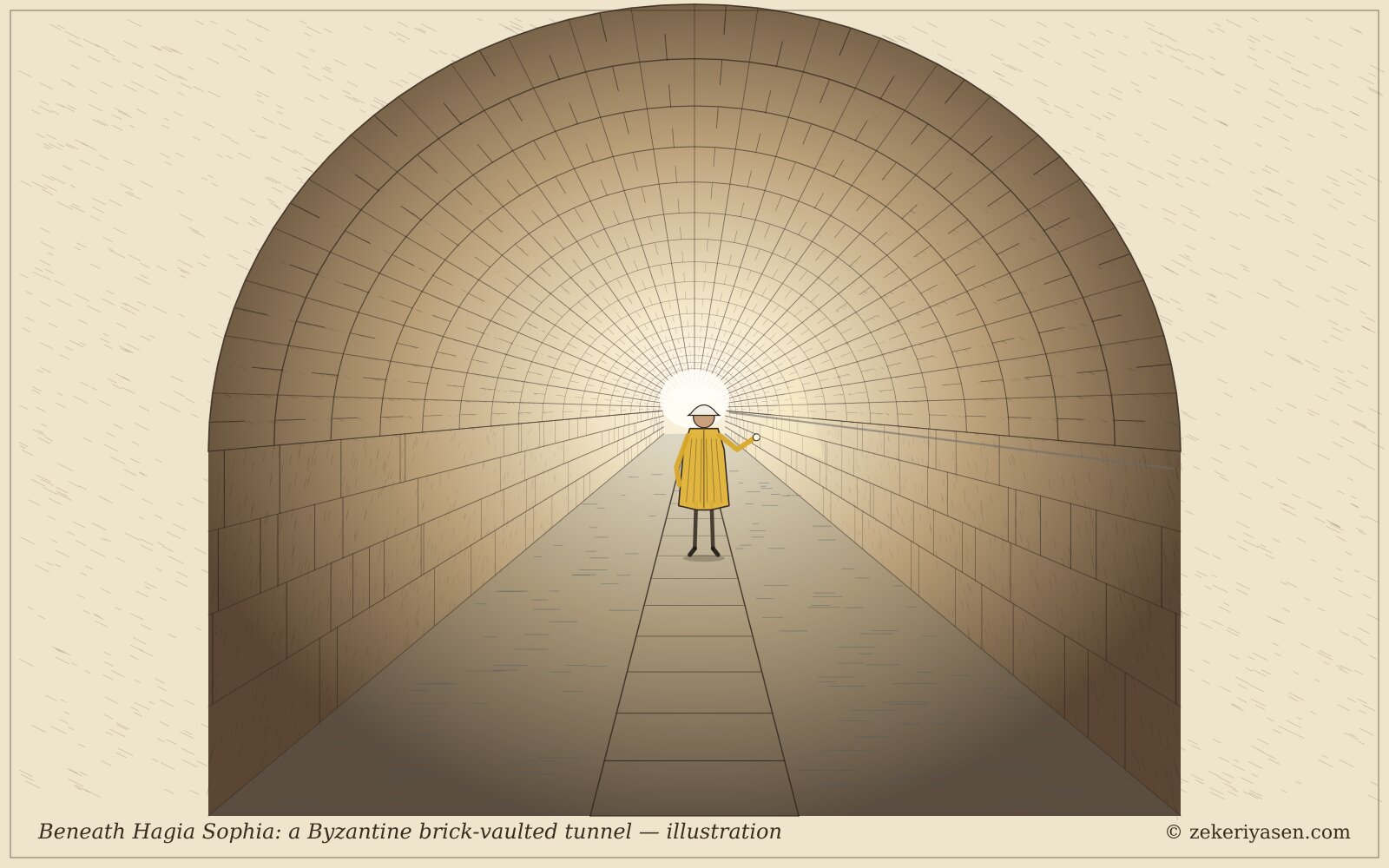
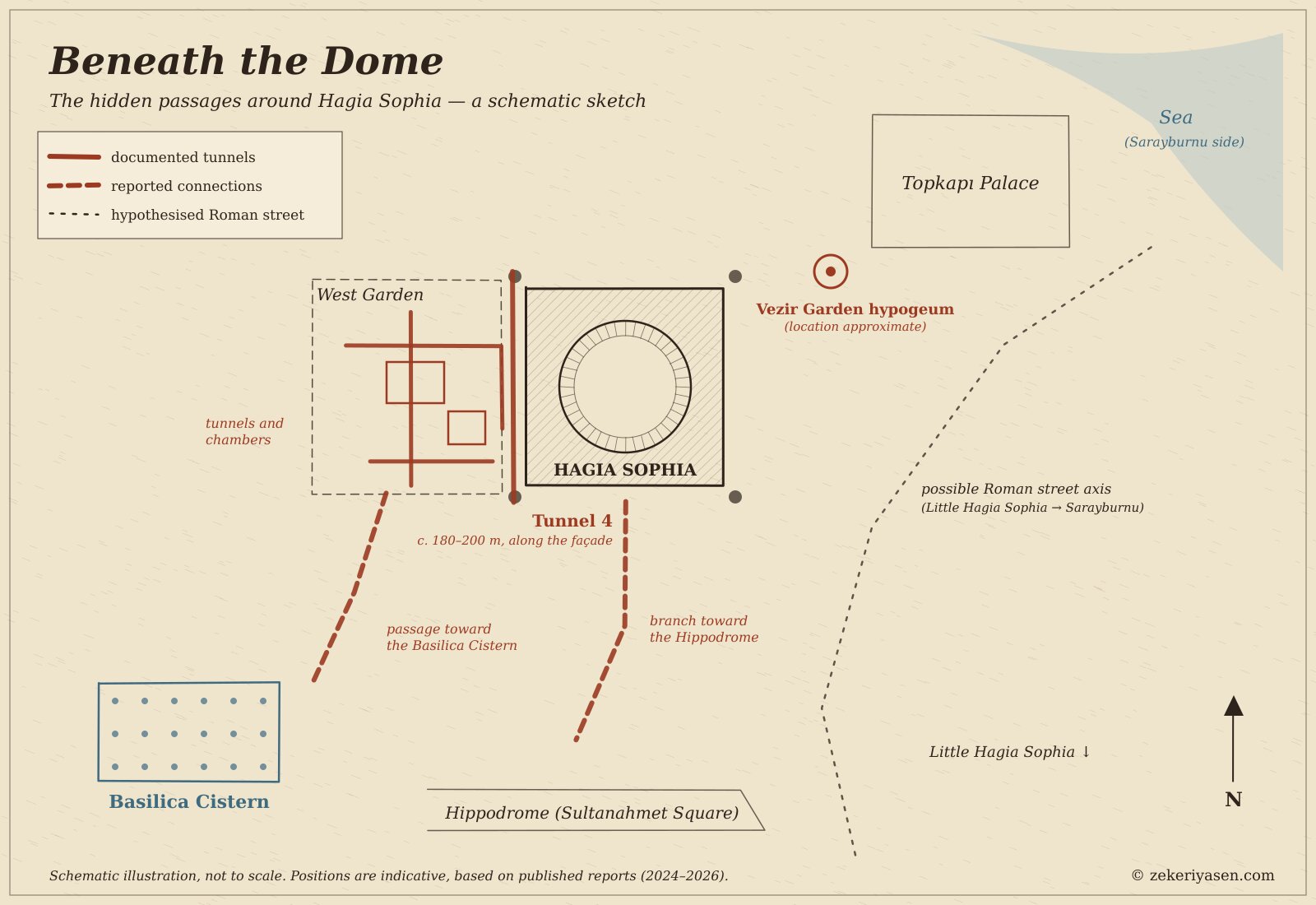
The 420 m of tunnel discovered so far, including the six newly discovered underground chambers in the western garden of Hagia Sophia, have now been largely cleared of fill. Seven of the tunnels have been completely emptied of soil and been surveyed and documented in detail. The longest of the tunnels, which have been provisionally called Tunnel 4, runs for some 200 m or so beneath the main front of the ancient building, following a gently sloping downward course of some three percent. Some of the underground rooms appear to have been the vaulted basements of parts of the ancient building’s great atrium, with its colonnaded courtyard. Others are entirely separate structures, constructed in one period and then reemployed for other purposes in a later era.
As for the amount of debris removed from the tunnels, it’s over 1,000 cubic meters (around 3,000 tons) of soil, washed into the tunnels through the centuries, garden soil from plants in the surrounding gardens that collapsed into the spaces below, and more. What has been uncovered is not a single corridor but a complex system of passages and tunnels, many dating back before the iconic Hagia Sophia itself.
One location in the Vezir Garden has now been completely cleared of the fill that was dumped in here after the roof collapsed. A further 1.5 m below the muddy floor of the long-abandoned tomb, first discovered here in 1946, the team reached levels dating back before Hagia Sophia as it now stands. A square chamber of about 8m x 8m in size with E/W running channels has been revealed.
One of the most beautiful things discovered in the tunnels is the water. One of the tunnels leads south to the Basilica Cisterns under the Hagia Sophia and water is still running in this tunnel coming from under the Hagia Sophia. It is not known whether this water is coming from a natural spring or from the old water distribution system of the Valens Aqueduct (Bozdoğan Kemeri) that still stands in the old city. The other tunnel leading from the cistern to the center of the Hippodrome was a Roman street running from the Little Hagia Sophia (Ayia Irene) down to the promontory of Sarayburnu. Unfortunately it has not been possible to confirm yet whether this tunnel is actually connected to this street, Tunnel 4 is running in the direction of this street.
A lot of space was needed beneath the floors of Hagia Sophia to enable the building to be filled with air and water in order to keep it dry and to allow for its maintenance. Water, which entered the building’s foundations due to its location in an earthquake zone and because of rainfall, needed to be drained and a way needed to be found to get rid of it. All these passages were needed to supply water to the Cathedral, to drain the rainwater from the building and the cathedral’s floor, to circulate air within the building to provide ventilation and for the building’s maintenance. The tunnel near the main entrance could possibly be used to provide fresh air to the interior of the Cathedral. However, this would be done by an outlet of approximately 2m2 near the main entrance and would not be sufficient to cover the entire interior of the building.
The tunnels and vaults are now being repaired using the original materials as far as possible. New stainless steel profiles are being used to support the ceilings. Laser-scans are being taken and the entire site is being documented.
A museum tunnel? At the moment the decision by the scientific board to allow visiting the tunnel(s) has not been taken yet. Much work needs to be done first. The Ministry of Culture however is preparing a display project to display parts of the found tunnel(s) should it be decided to open them to the public. Protection of the monument and public safety will be the two main conditions for the display.
It is to be hoped that they will finally be opened to visitors. The Basilica Cistern, the Cistern of Philoxenos, and now these under Hilia Sophia passages constitute the greater part of an underground Constantinople: the second city that continued to sustain the first for centuries. It will be fascinating to walk through the sections of this underground city that have been preserved in excellent condition and to get an insight into what the builders of the city were really trying to achieve.
The stories about boats and a secret corridor to the Topkapi Palace can now remain in the novels. What has been found is real and still partly hidden and moist. It will be uncovered gradually.
Illustrations: original sketches by zekeriyasen.com.