
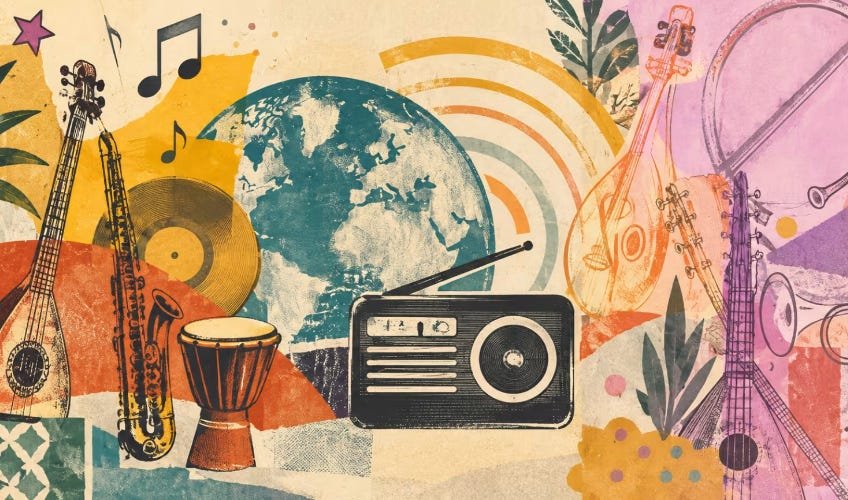

On 17 October 2026, my radio programme, Dünyayı Dinliyorum (Listening to the World), reached its 1,000th broadcast.
One thousand programmes. One thousand weeks. Nearly twenty years of sitting behind a microphone, first on Sundays and now on Saturdays, bringing sounds, stories, and musical traditions from distant corners of the world to listeners in Türkiye and beyond.
It is a milestone I could hardly have imagined when this journey began in 2006.
Back then, the station was called Açık Radyo, our dear friend Jak Kohen was still with us, and I arrived with a handful of CDs, an overwhelming curiosity, and a rather intimidating question: Would anyone actually want to listen?
I remember the nervousness of those first recordings. I remember wondering whether I had anything meaningful to contribute.
My ambition was surprisingly modest.
If just one person heard a piece of music from somewhere unfamiliar and thought, “I never knew this existed,” I would consider the programme worthwhile.
Twenty years and a thousand broadcasts later, I am still chasing that very same moment of discovery.
But something else happened along the way.
I began this programme hoping to understand the world through music. What I discovered was that music would also teach me how to understand myself.

The Most Important Thing I Learned Was How to Listen
We live in a world that rewards certainty.
Everyone has an opinion. Everyone is expected to have an answer. We are increasingly encouraged to react immediately, categorise quickly, and move on.
Music taught me something quite different.
It taught me to remain silent in front of a song sung in a language I did not understand. It taught me not to rush to conclusions about cultures unfamiliar to me. It taught me that understanding sometimes begins with accepting how little we know.
Perhaps the greatest gift of these twenty years has not been the accumulation of knowledge, but the growing awareness of how much remains unknown.
And that, I believe, is where genuine curiosity begins.
Over the past two decades, the world itself has changed dramatically.
Borders have hardened. Wars have multiplied. Millions have been displaced. Entire communities have struggled to preserve their identities, languages, and cultural traditions.
Yet music has continued to cross boundaries that politics cannot.
In refugee camps, protest squares, wedding celebrations, and modest family kitchens, people have kept singing.
Music has remained one of humanity’s most resilient forms of expression.
And week after week, I have tried to follow those voices.

Music Is Humanity’s Oldest Archive
Long before history was written in books, it was carried in songs.
A lullaby can preserve generations’ memory. A wedding melody can reveal a community’s social fabric. A lament can contain the history of displacement, loss, and belonging.
Listen carefully to a West African griot playing the kora, and you may hear an entire genealogy.
Listen to a Sámi joik, and you may encounter a landscape transformed into sound.
Listen to an Anatolian lament, and you may discover a migration story that no official archive has adequately preserved.
These are not simply musical performances.
They are living documents of human experience.
Traditions survive not because they are locked away in museums, but because they keep circulating, transforming, and finding new audiences.
A melody passed from mother to child may reappear generations later in a completely different setting. A village rhythm may eventually find its way into an electronic composition on another continent.
Culture is not static.
It lives through movement, exchange, and reinterpretation.
I have always seen Dünyayı Dinliyorum as a small part of that circulation.
My responsibility has never been simply to play music.
It has been to carry the stories behind the music to new ears.
Because a recording is only a recording until somebody listens.
And when somebody truly listens, the music comes alive again.

What Exactly Is World Music?
Over the years, one question has followed me more than almost any other:
“What kind of music do you actually play? World music? Ethnic music?”
It sounds like a straightforward question.
It isn’t.
The word “ethnic” often creates an uncomfortable distance between the listener and the music. It suggests something exotic, remote, perhaps even frozen in time.
As though the music belongs behind glass, waiting to be examined.
But every musical tradition is local to somebody.
In a street in Bamako, the pop music familiar to us may be just as culturally unfamiliar as the sound of a kora might be to someone in Istanbul.
The expression “world music” emerged as a commercial category in the late 1980s, partly to help record stores organise music that did not fit established Western genres.
It remains an imperfect label.
But I have come to think of it differently.
World music is not really a genre. It is a way of listening.
It means opening your ears to unfamiliar sounds without demanding that they conform to your expectations.
It means letting a piece of music tell its own story before imposing yours on it.
On my programme, a century-old lament may sit alongside contemporary electronic music from Lagos. A traditional string instrument may converse with jazz. Ancient vocal techniques may meet modern production.
There are no rigid borders.
Only the possibility of discovery.
And perhaps that is why the programme’s name has always felt right.
Listening to the World.
Not explaining it. Not categorising it.
Listening.

Behind Every Hour Is an Invisible World of Work
A one-hour radio programme can sound effortless.
The listener hears a carefully arranged sequence of music, a few stories, perhaps an unexpected discovery.
But behind that seemingly effortless hour lies enormous preparation.
Every week, I listen to dozens of albums.
I explore new releases, independent record labels, archival recordings, forgotten musical traditions, and contemporary artists working far beyond the mainstream.
Sometimes an entire album yields just one track worth sharing.
Sometimes none.
Finding the music, however, is only the beginning.
Then comes the research.
What language is being sung? What instruments are being played? What historical or cultural circumstances shaped the composition? Is this music associated with celebration, mourning, resistance, migration, or spiritual practice?
And how can I communicate that story in just a few sentences without oversimplifying it?
Introducing Tuvan throat singing, a Malian kora, or a Finnish kantele to someone hearing it for the first time requires more than enthusiasm.
It requires responsibility.
You must know enough to provide context, but also recognise when to let the music speak for itself.
Looking back at just the most recent two years of broadcasting, from November 2024 to October 2026, the numbers are revealing:
-
96 programmes
-
806 musical pieces
-
241 different artists
-
784 individually researched, written, and recorded introductions
And that represents only a fraction of the journey.
Multiply the preparation, research, listening, editing, and recording across twenty years, and the scale becomes difficult even for me to comprehend.
But another figure matters even more.
In twenty years, I have never missed a broadcast, and I have never repeated a programme.
Not once.
Consistency Is a Form of Respect
My professional life has taken me across continents, often with demanding travel schedules and responsibilities far removed from a recording studio.
Yet the programme has always been ready.
I’ve prepared broadcasts in hotel rooms, recorded announcements between journeys, and assembled entire programmes while travelling.
I vividly remember one occasion when I was on the road, the broadcasting deadline was approaching, and my recorded introductions had still not reached the production team.
I found a quiet place, pulled over, recorded the missing announcements, and delivered everything in time.
It was hardly a glamorous broadcasting studio.
But the programme went out as scheduled.
I’ve had countless moments like that.
Every programme has its own archive: music files, recorded introductions, playlists, and research notes.
Sometimes I have prepared two programmes in a single day before departing on a journey.
The locations have changed. The circumstances have changed.
The commitment has not.
I have never regarded that consistency as a personal achievement alone.
To me, it is a form of respect for the listener.
When somebody makes space in their life to listen to your work, you have a responsibility to honour that trust.
This principle extends far beyond radio.
Whether we work in travel, journalism, education, business, or the arts, consistency is rarely spectacular.
But over time, it becomes the foundation of credibility.

A Thousand Broadcasts, A Thousand Journeys
Looking through the programme archives feels remarkably like opening an old travel diary.
In January 2010, I devoted a programme to Ali & Toumani, the extraordinary collaboration between Ali Farka Touré and Toumani Diabaté.
In 2015, Toumani returned to the programme with recordings of his son, Sidiki.
To hear a musical tradition move from one generation to another, changing while preserving its essence, is to understand something profound about cultural continuity.
Across the years, the playlists have gradually become a musical atlas.
Shanren, carrying the sounds of China’s Yunnan mountains.
Kobo Town, drawing on Trinidad’s calypso heritage.
Mdou Moctar and Tinariwen, whose desert guitars have reshaped contemporary musical expression.
Noura Mint Seymali from Mauritania.
Park Jiha from Korea.
Wimme, one of the distinctive voices of Sámi joik.
And Fairuz, whose voice carries the emotional memory of Lebanon and much of the Arab world.
Different languages. Different histories. Different musical worlds.
Yet each recording offers another way of understanding the human experience.
For many listeners, these programmes provided their first encounter with artists they might otherwise never have discovered.
And somewhere, perhaps thousands of times, somebody must have thought:
“I never knew this existed.”
That remains the most meaningful measure of success I can imagine.
The Connection Between Travel and Music
People occasionally ask whether my work in cultural travel and my involvement in radio are separate pursuits.
I have never seen them that way.
Both begin with curiosity.
Both require us to move beyond the familiar.
Both demand that we approach another culture with humility rather than assumptions.
And both remind us that we cannot understand the world through superficial encounters.
A journey is not meaningful simply because we have arrived somewhere.
A musical experience is not meaningful simply because we have heard something unfamiliar.
The meaning emerges when we make the effort to understand the people, histories, and circumstances behind what we encounter.
In travel, I have always believed that the most valuable moments are not necessarily the grand monuments or celebrated landmarks.
Often, they are the conversations, unexpected encounters, and small cultural revelations that change how we see the world.
Music operates in much the same way.
It can take us somewhere we have never been.
More importantly, it can challenge the assumptions we carry about places we think we already know.
Travel teaches us to see beyond borders. Music teaches us to listen beyond them.
Together, they have shaped much of my understanding of culture, identity, and human connection.
Why Listening Matters More Than Ever
We live in an age of unprecedented access to information.
Algorithms recommend what we should hear. Digital platforms place millions of recordings within immediate reach. Artificial intelligence can identify musical styles, translate lyrics, and provide historical context almost instantly.
These are remarkable capabilities.
But access is not the same as understanding.
And hearing is not the same as listening.
An algorithm may introduce us to an unfamiliar musician.
It cannot decide for us whether we will approach that musician’s culture with genuine curiosity.
Technology can accelerate discovery.
It cannot replace the human willingness to pay attention.
After a thousand programmes, I am more convinced than ever that listening is not passive.
It is an act of openness.
Sometimes even an act of humility.
And in a world increasingly divided by fear, certainty, and prejudice, the ability to listen without immediately judging may be one of the most valuable cultural skills we can cultivate.

The Thousandth Programme Was Never Mine Alone
For the milestone broadcast, I did not want to sit behind the microphone alone.
I invited friends who have been part of this journey to share what Dünyayı Dinliyorum has meant to them and to select a piece of music.
İlknur Erk, Hilmi Tezgör, Ömer Şahin, Harun İzer, Levon Bağış, and Turgay Tuna joined me in celebrating the programme.
Their contributions reminded me of something important.
Although my voice may be the one listeners hear, this journey has never belonged to one person.
It belongs to the people who have kept independent radio alive, from Açık Radyo to today’s Apaçık Radyo.
To the producers, fellow broadcasters, musicians, researchers, and friends who have supported the programme over the years.
And above all, to the listeners.
Those who tune in every week.
Those who write to ask about a particular song.
Those who discover an artist and continue exploring long after the programme has ended.
And those who have quietly listened for years without ever sending a message.
We have listened to these thousand programmes together.
One Thousand Is Not an Ending
When I began in 2006, I wondered whether I could find enough interesting music to sustain a weekly programme.
Twenty years later, I face the opposite problem.
There is simply too much extraordinary music still waiting to be heard.
Too many languages.
Too many traditions.
Too many artists whose stories deserve to travel further.
Too many cultural connections still waiting to be discovered.
The world remains vast, complicated, frequently troubling, and endlessly fascinating.
And I remain as curious about it as I was when I first sat behind that microphone with a handful of CDs.
Perhaps even more curious.
Because after twenty years, I have come to understand that the purpose of listening is not to reach a point where we know everything.
It is to remain willing to discover what we do not.
One thousand programmes have not taught me everything about the world. They have taught me never to stop listening to it.
And next Saturday, we begin again.
With new sounds, new places, new stories, and hopefully a few more moments when someone, somewhere, says:
“I never knew this existed.”
Keep listening to the world.
Zekeriya Şen is a travel writer, cultural travel professional, and radio programmer. He is the General Manager and Co-Owner of FEST Travel and has presented Dünyayı Dinliyorum (Listening to the World) since 2006. The programme airs on Apaçık Radyo every Saturday.
This article is adapted from the original Turkish essay, “Bin Programın Ardından: Dünyayı Dinliyorum,” published by Apaçık Radyo on 16 October 2026.
Original article: https://apacikradyo.com.tr/programlar/dunyayi-dinliyorum/bin-programin-ardindan-dunyayi-dinliyorum