I had packed for cold. Siberia is one ofthose words that arrives with its own temperature, and even after thirty years in this business I anı not immune to it. Then I stepped out of the car on Krasny Prospekt at nine in the morning, in a shirt, and Olga looked at me and laughed. “You see,” she said, “we are like Turkey today. I mean the weather.”
Olga is a guide of the old school – a teacher first, a guide second, anda woman who has spent twelve years working the international scientific congresses that used to bring the world to this city. Vasily was driving. My group was somewhere else in the city that morning, doing the proper programme; I had one day anda professional’s greed to see what a place is actually made of. So we went looking.
A chapel in the middle of everything
We began in the main square, in front ofa small chapel that looks almost like a toy beside the bulk of the buildings around it. it was put up in 1913, when the Romanovs marked three hundred years oftheir dynasty, and it was placed here because this spot was then reckoned to be the geographical centre ofRussia. The middle ofthe largest country on earth, marked with a chapel the size ofa village bakery. it is dedicated to St. Nicholas, who, as Olga reminded me with the small satisfaction guides reserve for this line, is the patron saint of travellers. “So today he is yours.”
The street we were standing on is called Krasny Prospekt. Red Avenue – except that in old Russian, krasny did not mean the colour. it meant beautiful. This was the best street in what was then Novonikolayevsk, the new town ofNicholas il, so they called it the Beautiful Street, and the colour meaning came later and stuck. it runs ten kilometres, dead straight, and the locals will tel1 you it is in the Guinness book for it. What struck me was not the length but the width. Officials coming out from the capital at the turn of the last century complained – or marvelled, depending on who was writing – that it was wider than Nevsky Prospekt in St. Petersburg. The explanation is the most Siberian sentence I heard all day: there was a lot ofland, and it was free.
On both sides stand the red brick houses ofthe merchants who arrived early and did well. A city that was a construction camp in 1893 hada merchant class with brick façades within twenty years. That tells you something about the speed of the place.
The cathedral that would not be blown up
We stopped at the Alexander Nevsky Cathedral, which by chance we were visiting on the day Russia commemorates its baptism. Olga told me its architect had taken his design from Hagia Sophia, and I stood there in front ofit trying to see my own city in a Siberian church. The proportions want to be Constantinople; the brick and the climate say otherwise. But the impulse is there.
The story of the building is better than the architecture. Before the cathedral there was a railway wagon. The men building the Trans-Siberian line arrived ata place that was nothing but taiga, and they needed somewhere to pray, so a wagon was pushed onto this ground, icons were hung inside, and that was the church. The stone one came at the end of the 1890s, and the walls were built thick.
Thick enough that after 1917, when Moscow ordered it destroyed, they could not do it. Explosive was packed into the cellar. it went off. The cathedral stood. A telegram came: increase the charge. They did. The cathedral stood, and the surrounding buildings – where the Party members lived – cracked. A third telegram came, and the local engineers wrote back that with the means available it could not be done. So it was simply closed, and it waited.
inside, the acoustics are extraordinary. Olga said they invite choirs to sing here, and that when the boys’ choir sings, people feel the sound is arriving from above rather than from in front. I believe it. She also pointed out a Christ figure painted where the eyes follow you across the floor, and gave me her grandmother’s version of it: you can deceive me, but look at God, He sees you wherever you are. So behave.
Then there is the icon. A miracle-working icon, with a frame made entirely of jewellery-chains, earrings, rings – brought by women who came to ask fora child and came back to give thanks. it is behind glass now, because gold attracts other kinds of visitors, but you can still watch women stop, bow, and kiss the case. Whatever your position on miracles, that frame is a hundred years of hope, melted down and hammered flat.
Hagia Sophia, from the other end
Standing in a church built in imitation ofHagia Sophia, we ended up talking about Hagia Sophia. Olga had seen it. She thought converting it back into a mosque had been wrong – not because of religion, she said, but because it is a work of art.
I did not defend it. I explained what I believe: that Fatih’s conversion in 1453 was the act ofa conqueror in the fifteenth century, and that repeating the gesture in the twenty-first is theatre. it is a building that was never designed to hold that volume of daily use; it is wearing down under it. The revenue was cut off overnight, and shortly afterwards there was a scramble to open other doors to make up for it. And during prayers the icons are covered, which is its own small confession – everyone knows exactly what is being managed.
Olga’s answer was to tel1 me about Kazan, where they have built a magnificent mosque and left the Christian sites standing beside it, and where, she says, nobody makes a quarrel out ofthe arrangement. Build the new thing next to the old thing. it is nota complicated idea.
We agreed, in the diplomatic shorthand oftwo people who like each other, that this was politics rather than faith, and left it there.
A hundred flats and a key under the rug
Further along Krasny Prospekt, Olga pointed out the building everyone here calls the Hundred-Flat House. Finished in 1937, and its design took a Grand Prix in Paris that same
year – a fact the city has never got tired of. The plan had been to rebuild much of Novosibirsk in this style: new city, new life, new everything. Then 1941 arrived and the money went where money goes in a war.
The flats are large, the windows enormous and double-framed. An English architect once asked Olga why, in a place where the thermometer reaches minus forty, they did not simply build small windows. Her answer: because heating is not our problem. Wood, coal, gas, oil – Siberia has never lacked for energy, only for people.
The detail I keep thinking about is the balconies. They run continuously along the façade, so that a person living at one end can walk along and step into a neighbour’s flat at the other. That was not an accident of design; it was the design. Olga’s father was chief engineer ofa large construction company, a big manin the local sense, and on weekends he forbade her to lock their door. “Do you have secrets from your neighbours?” Her mother would make pancakes and piroshki and anyone could come in for tea. When she went to school she locked the flat and left the key under the mat outside, for whoever might need it.
I asked the obvious question. She said erime was not a problem then, and that the change came drastically, and that the worst of it was the 1990s: factories closing, wages vanishing, people simply grabbed in the street.
Then she told me she had once been interpreting foran American businessman here when two men in black walked into the room and pointed guns at them. She thought it was a performance – a joke, a play- and stood up and took hold of the pistols to ask what they thought they were doing. The American had gone white. it turned out the local partner owed money to someone. Afterwards the man told her he would pray for her for the rest of his life, because without her he would have been killed. A great many people were killed in those years.
She tells this story the way people tel1stories about weather they have survived.
Where the city actually starts
We drove down to the Ob. This is the reason Novosibirsk exists, and it is a story about engineering, not about kings.
The Trans-Siberian was begun in 1891 under Alexander 111, and the crews worked towards each other from both ends. They had to cross the Ob somewhere. The original plan put the bridge some twenty kilometres north, at an old Siberian settlement – but the West Siberian Plain is the flattest country on earth, and there the river spreads out at flood to a width oftwelve kilometres. So the engineers went looking for something better and found this place: eight hundred metres across, and shallow. The first pier stone went down in 1893, and that is the year the city counts as its birth. No decree, no founder, no plan. A bridge site, and then everything else.
When the bridge was finished the river was frozen, and everyone who had worked on it – men and horses both – was made to stand on the ice underneath while the first train crossed over their heads. There is a photograph. it is, from a modern safety perspective, magnificent.
The iron span was replaced not long ago because of metal fatigue, and one section of the original has been set up on the bank asa monument. it is riveted, not welded. Olga says the engineers told her the riveted work is the more reliable ofthe two, and then wondered aloud whether they had been teasing her. I said the old hands say that everywhere in the world.
The old stuff is always stronger; sometimes it is even true.
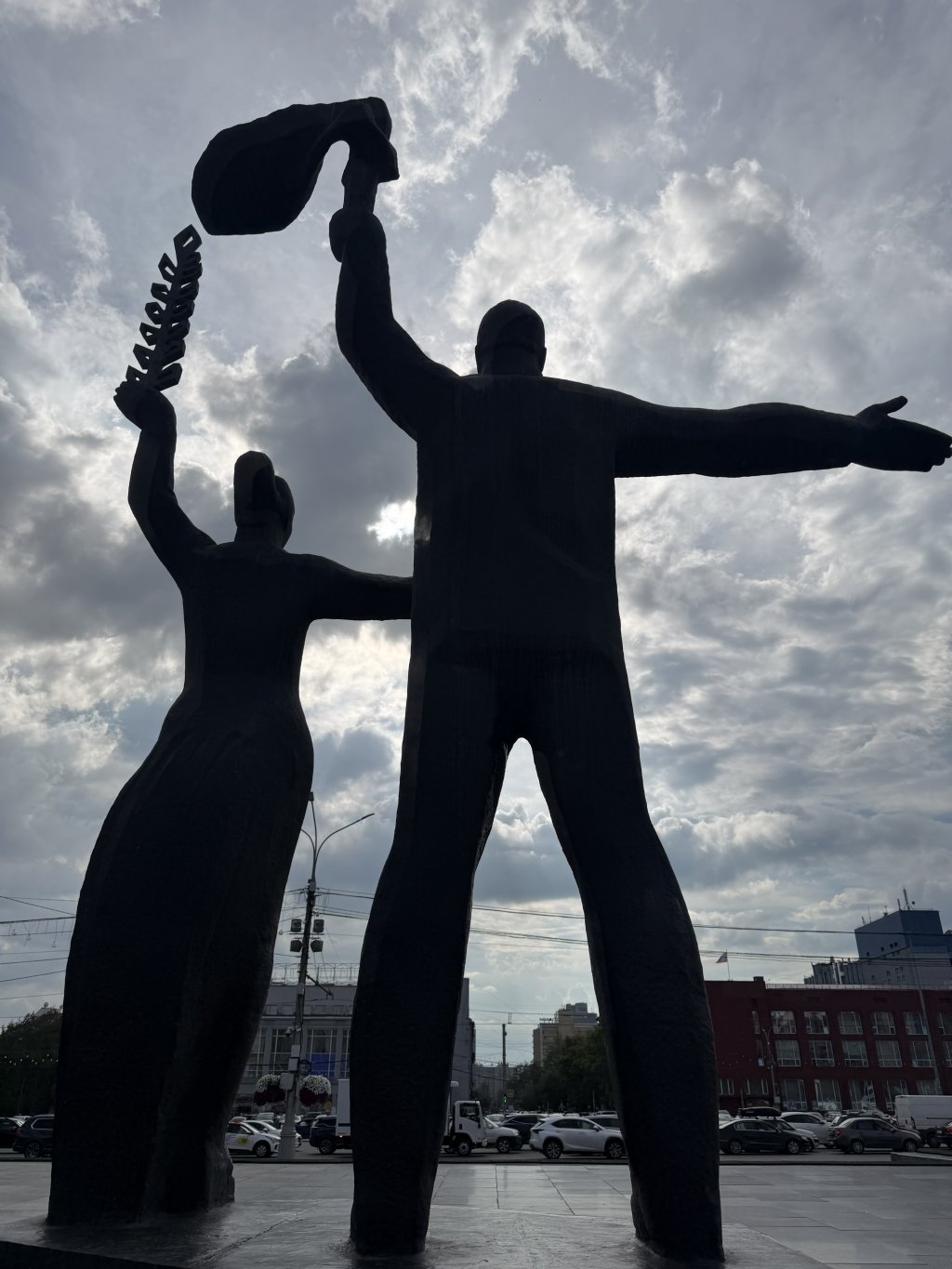
Beside it stands Alexander 111, who gets called the peaceful tsar here because he started no wars, and who apparently entertained his European royal relatives by bending coins between three fingers and handing them over as souvenirs. He is said to have got under a horse and lifted it. He reigned briefly and died of his kidneys, and he began the railway that made this city.
The name ofthe river, Olga told me, is thought by linguists to be Turkic rather than Slavic-one of those small shocks of recognition you get travelling east, where my language keeps turning up in the ground under other people’s cities. She had once worked a conference on Altaic languages here, with scholars from Turkey among them. There is also a legend: two rivers came down out of the Altai and made a third, and argued so long over what to call it that an old man passing by told them to name it Both. Ob. The ending fell away, as endings do.
Then there is the metro bridge, painted green, carrying the underground across the water and back below ground on the far side – they went over rather than through because the city sits on a granite platform and drilling it would have cost a fortune. The thing expands and contracts by about a metre between minus fifty and plus thirty-eight, and it rides on rollers that spread apart in the heat and close up in the cold. A metre. A bridge that breathes.
The road south
Out of the city the road runs past grain silos, and Olga mentioned, in passing, that a good deal of the wheat Turkey buys comes from this region and the Altai beyond it. She had bought Turkish raspberries the day before and could not work out how they get here – bus, train, truck, she had no idea, only that it is a long way and the price says so. Two countries feeding each other across five thousand kilometres, and nobody in either one thinking about it for more than a second. This is the part ofmy job I never get tired of.
We passed the test plots ofthe agricultural academy-ten institutes out here, working on grain, soils, livestock – where they have developed frost-resistant wheat that is sown in autumn and comes up as soon as the snow goes, and hardy potatoes fora growing season that runs about a hundred days. Before the sanctions the Canadians came regularly to compare notes, having the same weather and the same problems. Beyond the plots, the dachas: small plots given out free in Soviet times, small houses built on them by hand, families going out for the week in summer. Olga’s father got one. Practically everyone has one.
She talked about the climate changing, and it was not an abstraction to her. Warming here has run roughly twice the European rate, and one hypothesis blames the methane coming out of what is the largest marshland in the world. The permafrost boundary is retreating
north. in Yakutia they built the apartment blocks on piles, precisely so the warmth of the buildings would not melt the ground beneath them, and now the ground is melting anyway and the piles are shifting, and one company has proposed freezing units around every single pile. Nobody knows what that would cost. Nobody can pull down a whole city.
“But for us Siberians,” she said, “we can grow vegetables outside now. We welcome it.” Then she thought about the fires in Spain and France, and the people dying ofheat in London, and stopped welcoming it.
Akademgorodok
Finally the reservoir – the Ob Sea, two hundred kilometres long, made by adam that raised the water twenty metres and drowned a great deal of country. in winter the ice is covered with fishermen and the groups love it; that morning it was empty and enormous and blue.
And on its shore, in the middle ofa pine forest, the academic town.
This is what I came for. More than thirty research institutes – physics, nuclear physics, mathematics, biology, geology, geophysics, genetics, five for chemistry alone, including one ofthe very few institutes in the world dedicated to catalysis – all ofthem built together, inside virgin forest, on the argument of one man. Academician Lavrentiev travelled the whole of Siberia looking for the right ground, and he insisted that scientists of different disciplines had to live in one place, on one street, so that a physicist who needs a mathematician can cross the road and get one. That, he said, is what progress is.
The reason it is out here at all goes back to Khrushchev, and to the war. Every city in the European part of the country had been flattened once; if it happened again, the country would need a brain somewhere beyond the Urals. So they built one in a forest, thirty kilometres from a city that had itself only existed for sixty years.
Olga says foreign scientists arriving from the airport used to get frightened on this road – the forest goes on and on, and they had been told what Russia was, and they wondered where exactly they were being taken. Then the trees open and there are institutes.
Olga
She is seventy-something,1would guess, and her mother turned a hundred last week – a woman whose family were rich, were declared enemies by Stalin, were stripped of everything and exiled north along this same river, and who survived on fish. So much fish that the old lady will not touch it now. Before the war, Olga said, black caviar was cheaper than meat here, because nobody had to pay for the fish.
That is one lifetime, from a caviar-poor exile on the Ob to a hundredth birthday party in a city with a metro. it is the whole century, and it was sitting in the front seat ofthe car telling me about catalysis.
1anı in the business ofmoving people across the world, and I have long since stopped believing that the sights are the point. This was a day ofa chapel, a street, a church that refused to be demolished, a bridge, a reservoir, and a forest full of laboratories. What I will remember is a woman explaining thermal expansion, then explaining her mother’s exile, in the same tone of voice – and a door in a Siberian apartment block, left unlocked on a Sunday, because what secrets could you possibly have from your neighbours.